

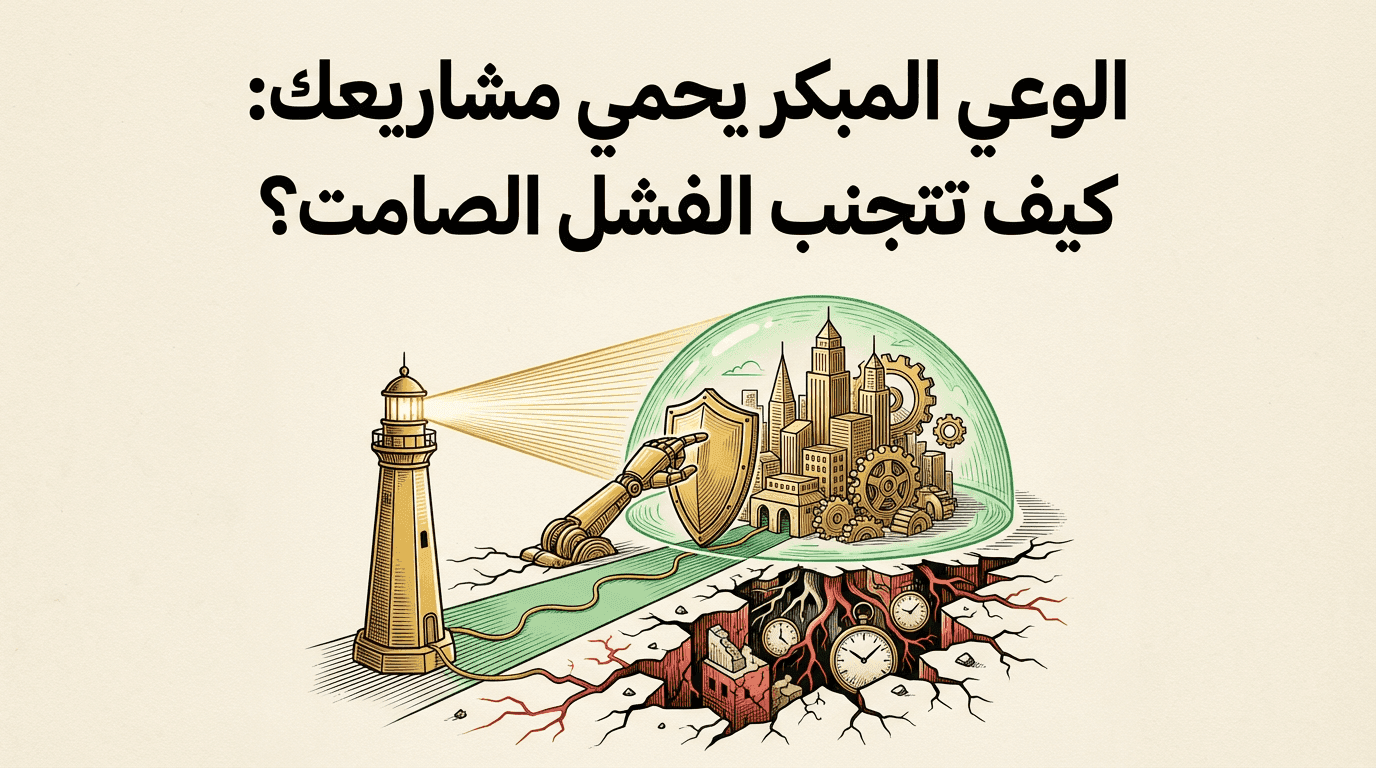
In business and projects, a conscious beginning and an early understanding of project risks are often the difference between success and silent failure. Many projects falter not due to a lack of resources or capabilities, but because of ignoring the early warning signs that indicate the presence of gaps or potential problems.
The Importance of Early Awareness in Project Management
Early awareness means the ability to sense challenges before they escalate, understand market dynamics, and identify internal weaknesses within team dynamics or operational processes. Projects that rely on proactive planning and rigorous data analysis avoid many hidden risks and exhibit greater agility in facing sudden shifts.
Silent Failure: The Hidden Enemy
Silent failure is that which creeps in gradually without leaving obvious traces initially. It often manifests as a progressive decline in performance, a weakening commitment to deadlines, or a deterioration in the quality of products and services. Detecting this type of failure requires precise monitoring of key performance indicators (KPIs) and a continuous review of adopted strategies.
Strategies for Preventing Silent Failure
-
Comprehensive Risk Assessment: Before launching a project, a list of potential risks must be established and prioritized. This exercise provides the team with a proactive awareness of scenarios that the project might encounter.
-
Continuous Information Updates: The environment surrounding a project is constantly changing. Tracking economic updates, technological advancements, and competitor analysis can provide vital insights to adjust strategies in a timely manner.
-
Building a Culture of Open Communication: When the team feels free to discuss errors and apprehensions, it becomes easier to uncover problems in their early stages before they escalate into major crises.
-
Utilizing Smart Performance Indicators: Closely monitoring specific indicators helps detect any deviation from intended goals, thereby enabling rapid intervention to correct the course.
-
Continuous Learning from Past Experiences: Successful projects often benefit from analyzing previous triumphs and failures, deploying these lessons to mitigate future risks.
The Balance Between Planning and Execution
Early awareness does not mean settling for planning alone; rather, it must be integrated with the capability for flexible execution. Project teams that combine deep analysis with swift action in the face of challenges display a higher success rate. Agility enables the project to adapt to sudden changes, whether internal or external, without losing control over core objectives.
Conclusion
Early awareness is not a luxury; it is a strategic necessity for any project aspiring to achieve sustainable success. By implementing mechanisms for the early detection of risks, monitoring performance, and adopting a culture of continuous learning, organizations can mitigate silent failure and transform challenges into opportunities for growth and development. Ultimately, successful projects are those that foresee before events occur and act before risks escalate.