

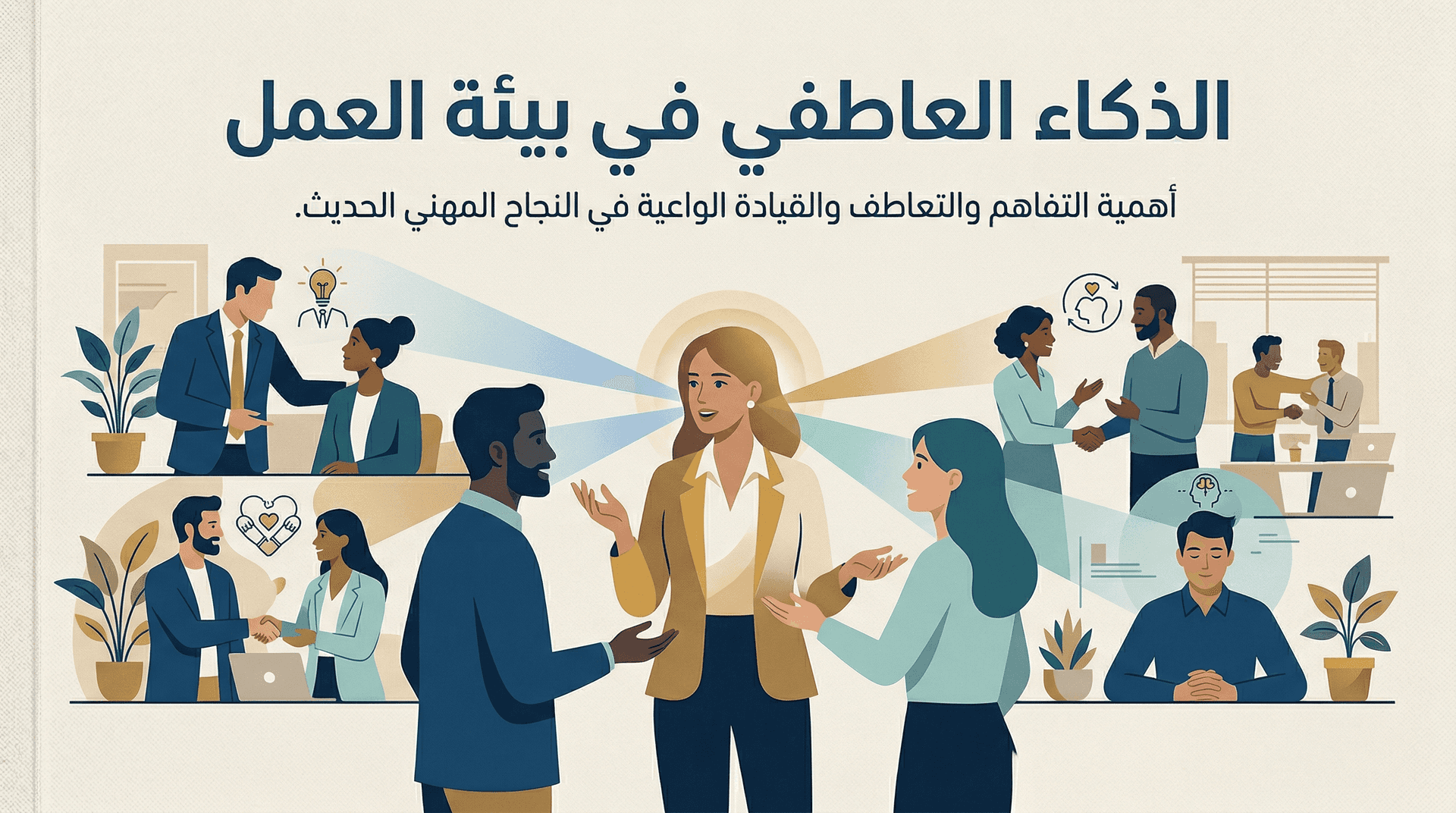
Emotional Intelligence: The Skill That Transforms Work Environments
In a world where challenges have accelerated and job roles have become more complex, it is no longer enough to possess high technical skills or long years of experience to guarantee success. Organizations today face increasing pressures, constant changes, and work teams with diverse backgrounds and expectations. In this context, success is no longer measured solely by what you know, but by how you handle yourself and others.
This is where Emotional Intelligence (EQ) emerges as one of the most important skills that make a real difference. It is the ability that enables you to understand yourself, manage your emotions, empathize with those around you, and build healthy, sustainable professional relationships. The difference between a team that works in harmony and one that suffers from tension is often not found in technical skills, but in the level of emotional intelligence among its members.
What is Emotional Intelligence?
Emotional Intelligence is the ability to recognize, understand, and manage your own emotions and the emotions of others in a way that enhances performance and relationships. It consists of five key elements that together form an integrated system:
1. Self-Awareness
This is the starting point for everything. It is recognizing your emotions in the moment and understanding how they affect your behavior and decisions. A leader who realizes they become stressed under the pressure of deadlines can deal with this feeling consciously, rather than letting it reflect negatively on the team.
2. Self-Management
This means the ability to control reactions, especially in difficult situations. Instead of reacting impulsively or casting blame, the focus is on solutions. This skill creates a more stable work environment and fosters trust within the team.
3. Social Awareness
It is the ability to understand the feelings of others, read between the lines, and pay attention to non-verbal cues. In a work environment, this means realizing when a colleague is under pressure or when they need support—even without them asking for it.
4. Relationship Management
Building strong professional relationships, communicating effectively, and resolving conflicts in a constructive manner. A successful team is not one that is free of disagreements, but one that knows how to manage them without turning them into conflicts.
5. Internal Motivation
This is the drive that keeps you going despite challenges. People with high emotional intelligence do not give up easily; instead, they see failure as an opportunity for learning and improvement.
Why Does It Matter in the Work Environment?
Numerous studies indicate that the majority of professional success does not depend on technical skills alone, but on behavioral and human skills. Teams that enjoy high emotional intelligence are more productive, less stressed, and more capable of adapting to changes.
Conflicts in the workplace are often not caused by technical differences, but are the result of misunderstandings, poor communication, or a lack of empathy. When individuals have the ability to understand one another, these conflicts decrease significantly, and the work environment transforms into a space of cooperation rather than conflict.
A Real-Life Story: From Chaos to Success
In one major project, there was a team suffering from constant problems: delays in delivery, tension between members, and an increasing desire to leave the project. When a new leader was appointed, the expectation was that they would start by imposing order and tightening control. However, they chose a different path.
The leader started by listening. They sat with every individual on the team, asked them about the challenges they faced, and listened sincerely to their fears and pressures. They did not try to correct everything immediately; instead, they focused on understanding first.
Then, the leader shared personal experiences, including past mistakes, which created a level of trust and openness. After that, they worked with the team to build a joint plan, ensuring that every individual felt they were part of the solution rather than just an executor of instructions.
When mistakes occurred, the question was not "Who is at fault?", but "What happened? And how can we learn from it?".
Within a few months, the team changed remarkably. Delays decreased, commitment rose, and the work environment transformed from a state of tension to a space of cooperation and support. This transformation was not due to new tools, but due to a change in the way of thinking and interacting.
How to Develop Emotional Intelligence?
For Individuals:
- Start by monitoring yourself: Document your daily situations and notice how you react to them.
- Take a moment before responding: Sometimes, a few seconds are enough to change the outcome of an entire conversation.
- Listen with focus: Do not listen just to reply; listen to understand.
- Pay attention to non-verbal cues: Body language and tone of voice carry deeper meanings than words.
For Leaders:
- Build a psychologically safe environment where the team feels comfortable expressing their opinions and fears.
- Acknowledge feelings: Saying "I understand that this is difficult" can be more powerful than any administrative directive.
- Encourage continuous learning in communication and leadership skills.
For Organizations:
- Integrate emotional intelligence into hiring and evaluation criteria.
- Provide continuous training programs, rather than temporary initiatives.
- Make this skill part of the organizational culture, not just a theoretical concept.
Emotional Intelligence in Project Management
In the environment of project management, the importance of emotional intelligence is multiplied. A project manager does not deal only with tasks and schedules, but with people who have different expectations, fears, and motives.
Success in this context depends on the ability to:
- Understand the needs of stakeholders, even the unstated ones.
- Manage resistance to change in a human way, not an imposed one.
- Maintain team morale during periods of pressure.
- Negotiate smartly by understanding what the other party actually wants.
Conclusion
Emotional intelligence is not an exclusive innate talent; it is a capability that can be developed through practice and awareness. Every day at work provides an opportunity to apply it, and every interaction is a space for improvement.
It might start with a simple step: stopping for a moment before you respond, asking a sincere question, or trying to understand a different point of view. These small details are what make the difference in the long run.
In the end, successful work environments are not built only on efficiency, but on understanding, trust, and the ability to work together toward a common goal. Emotional intelligence is the foundation upon which all of that is built.