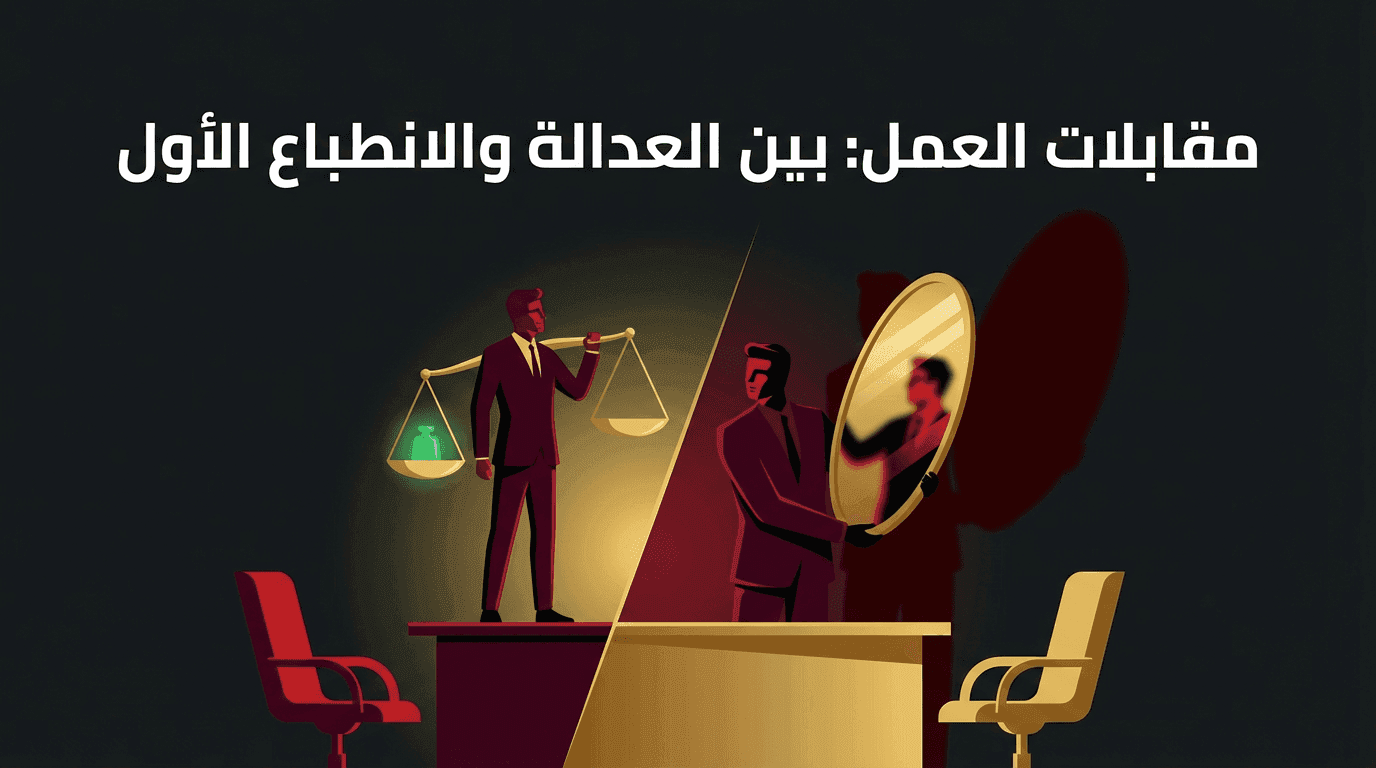
In the contemporary professional landscape, job interviews have become akin to a mirror that reflects an organization's culture just as much as it reveals a candidate's capabilities. However, the question arises: Does every job interview actually reflect standards of fairness and objectivity?
Many candidates enter the interview room filled with hope, only to leave with the impression that the decision was not necessarily built on competence or experience, but perhaps on a first impression or even unconscious bias. Here, the need emerges to reconsider the credibility of job interviews and their role in building fairer and more professional organizations.
The Interview as a Dual Tool
Theoretically, interviews are designed to be a tool for measuring competence, problem-solving ability, and adaptability to the work environment. In practice, however, they can turn into a psychological testing ground, where candidates are judged based on their personalities or speaking styles more than their qualifications.
This deviation weakens the primary goal of the interview: choosing the right person for the right place. How many high-caliber talents have been lost due to poor communication skills, and how many charismatic personalities have secured jobs despite having limited skills?
Where Does Bias Hide?
Forms of bias in interviews are multi-faceted:
- First Impression Bias: Where the interviewer judges the candidate within the first few minutes and projects that judgment onto the rest of the conversation.
- Cultural or Social Bias: Where a candidate from a specific background is preferred simply due to similarities with the team or the manager.
- Unprofessional Questions: Which reveal a lack of preparation, or an attempt to test the candidate outside the scope of the job.
Bias does not only harm the candidate; it harms the organization itself, as it might lose the opportunity to attract top talent.
The Organization's Responsibility
Leading organizations realize that an interview is not just a test for the applicant, but also a test of the organization's image. A fair and professional interview reflects a serious and responsible work environment, while an improvised interview reveals weakness in the hiring culture, and potentially an environment that fails to attract talent.
Therefore, it has become essential for interviews to rely on clear standards, such as:
- Having a diverse interview panel instead of a single individual.
- Relying on objective evaluation matrices that reduce the impact of bias.
- Designing questions directly related to the required tasks.
The Candidate's Responsibility
Credibility is not the organization's responsibility alone. The candidate also bears an important role in:
- Good Preparation by understanding the company's nature and its role.
- Asking Smart Questions that reveal the organization's culture and the reality of the work environment.
- Evaluating the Experience: The manner of the interview itself is an indicator of the organization's quality.
In this way, the candidate is not just a recipient of a verdict, but a partner in evaluating fairness and credibility.
Toward Fairer Hiring Practices
The global scene is witnessing a shift toward more objective alternatives, such as practical tests, short internships, or Assessment Centers that measure actual skills away from fleeting impressions.
These practices may not eliminate interviews entirely, but they place them in a broader and fairer context, where hiring decisions are built on actual performance rather than personal impressions.
Conclusion
Rethinking the credibility of interviews is not just a procedural step; it is a cultural shift that reflects the maturity of organizations and their commitment to excellence. Fairness in hiring does not only create a more equitable environment, but it also boosts employee loyalty and opens the door to genuine diversity in talent—which forms the foundation of any sustainable professional success.