

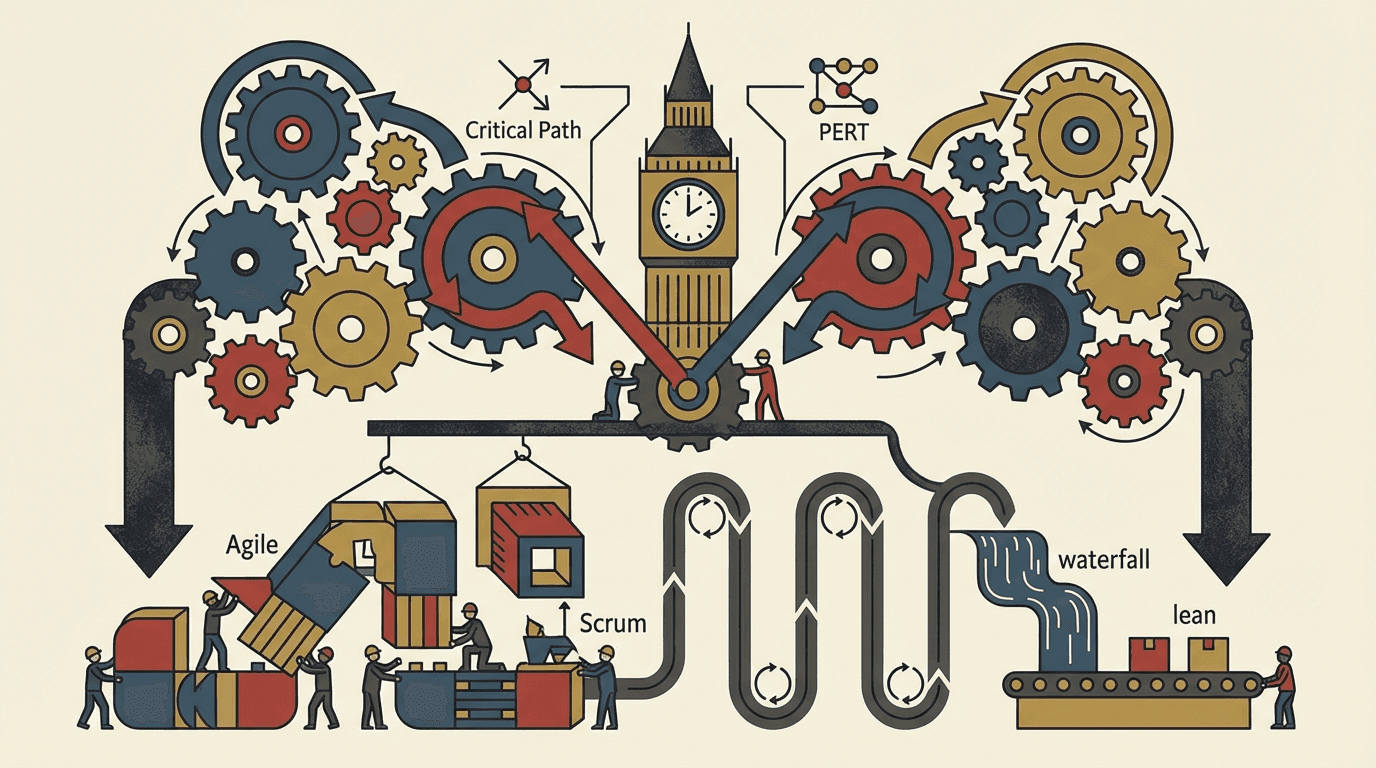
In the world of project management, there is no ready-made recipe that fits every time and place. Projects vary in size, nature, and work environment; therefore, successful management requires intellectual flexibility and the ability to choose or adapt the appropriate theory for each case. This highlights the importance of being familiar with the most famous theories in project management—not as a single absolute choice, but as a toolkit that allows a project manager to select what serves their goals and addresses their challenges.
1. Integrated Project Management
This theory relies on the integration of all project management elements: planning, execution, monitoring, and evaluation. It offers a holistic view that balances technical, social, and economic aspects, making it suitable for complex, multi-dimensional projects.
2. Strategic Leadership
Here, leadership becomes the primary driver of success. The project manager is not just a task coordinator but a leader with a strategic vision, capable of motivating the team, guiding them, and ensuring the project aligns with broader institutional goals.
3. Innovative Project Management
This focuses on innovation as a core element. It calls for using new tools and unconventional ideas, encouraging continuous creative thinking to develop processes and achieve added value.
4. Sustainable Project Management
This theory links economic, social, and environmental dimensions, emphasizing the organization's responsibility toward the future. In light of the global trend toward sustainability, this theory has become essential, especially for projects with social or environmental impacts.
5. Earned Value Management (EVM)
Focuses on measuring performance, cost, and schedule simultaneously. This theory provides accurate indicators to determine whether the project is proceeding according to plan or requires early intervention to correct its course.
6. Critical Chain Theory
Seeks to optimize time and resource management by focusing on the critical path and the activities that most influence the project duration. It is ideal for projects facing time constraints or limited resources.
7. Social Project Management
Highlights the human and cultural dimensions, where communication and cooperation among team members become the cornerstone. It does not focus solely on schedules but on the human dynamics that drive the project.
8. Innovation in Project Management
Similar to Innovative Project Management, but goes further by making innovation part of the institutional methodology itself. The goal here is not just to improve a single project but to build a sustainable culture of innovation.
9. Strategic Project Management
Links the project to the overall corporate strategy, ensuring that each project is not just an isolated activity but part of a system that achieves the organization's vision and supports its competitiveness.
From Theory to Impact
Theories in themselves do not guarantee success. The real power lies in the project manager