

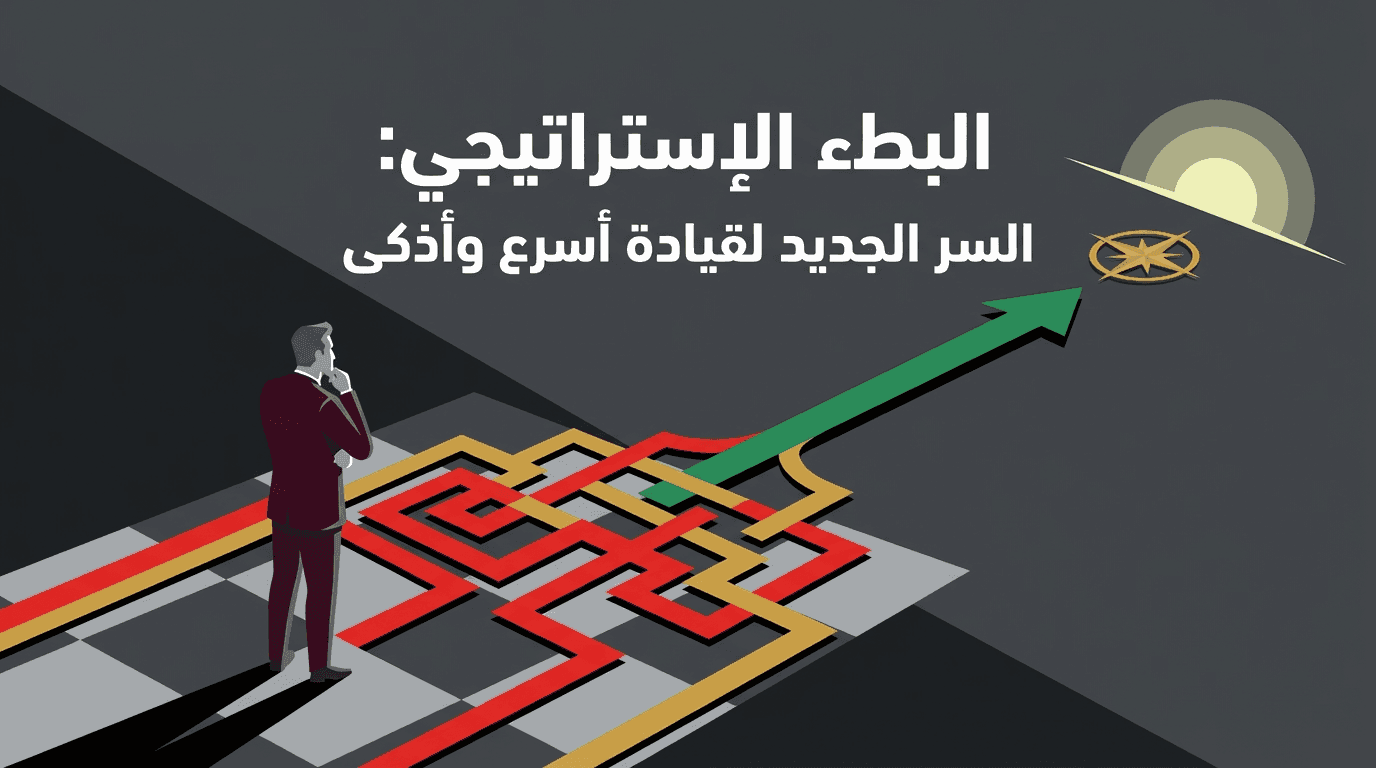
Strategic Slowness: The New Secret to Faster and Smarter Leadership
In an age where a leader's value is measured by the ability to move quickly, a contrasting concept emerges to redefine effective leadership: Strategic Slowness. This is the philosophy that teaches us that stopping is not a retreat, but a necessary step toward a stronger start, and that wisdom is not born in haste, but in the spaces we create for reflection and contemplation.
In boardrooms, business accelerators, and even in the individual experiences of entrepreneurs, it becomes clear that those who move with great speed are, in fact, those who have mastered the art of deliberate deceleration. This is not a call for laziness or procrastination, but for consciously managing the rhythm between what the Greeks called Chronos (quantitative time—clocks, schedules, deadlines) and Kairos (qualitative time—the right moment, the golden opportunity).
The Rhythm of Leadership: From Motion to Impact
The most influential leaders realize that speed alone is not enough. Excessive speed can produce rushed decisions, incomplete projects, or exhausted teams. Strategic slowness, however, allows a leader to:
- Capture subtle signals amidst the noise.
- Give creativity space to breathe.
- Shift focus from mere achievement to deep accomplishment.
It is a philosophy similar to that adopted by special forces: "Slow is smooth, and smooth is fast." Gradualness and clarity provide a competitive advantage that far surpasses uncalculated rushing.
The Integrated Performance Trio: Move, Think, Rest
This philosophy can be summarized in a practical, integrated rhythm:
- Move: Conscious movement—such as a walking meeting or short physical activity—allows the body and mind to realign and harmonize.
- Think: Allocating time for strategic thinking away from the pressure of tasks, allowing for a broader vision and wiser decision-making.
- Rest: Rest is not a luxury, but a mechanism for restoring emotional and mental clarity, providing space for the subconscious mind to innovate unexpected solutions.
Emotional Recovery: The Forgotten Dimension of Leadership
A leader carries more than just administrative responsibilities; they daily receive waves of emotion—team anxiety, the excitement of achievement, and the energy of conflict. Without emotional recovery mechanisms, they become an overburdened storehouse, unable to support those around them.
Recovery here does not only mean an extended vacation, but daily practices: moments of silence, quick journaling, or even a few minutes of deep breathing between meetings.
How Does a Leader Apply This Philosophy?
- Allocating thinking time within a crowded schedule.
- Adopting the 24-hour rule before making fateful decisions or sending sensitive messages.
- Designing slow tracks for certain projects to allow time for maturity.
- Building short but regular emotional recovery rituals.
- Daring to say "no" to what is urgent but valueless, to protect what is truly important.
The Competitive Advantage of Conscious Slowness
In a world saturated with speed, the consciously slow leader becomes rarer and, therefore, more valuable. This is the leader who does not confuse motion with progress, and who understands that the rarest resource is not time, but attention.
These leaders do not just survive; they create impact. They establish a deeper vision, build longer-term trust, and lead their organizations with the speed of wisdom, rather than the speed of fear.