

As the end of the year approaches, many professionals find themselves caught between the race of delayed accomplishments and the pressure of early planning for the coming year. Days pass quickly, and a whole year wraps up without us giving ourselves a quiet moment to understand what actually happened. And here, a precious opportunity is lost: the opportunity for mindful reflection.
At Shurooq, we believe that the right beginning does not come from enthusiasm alone, but from clarity. And clarity is only built when we take a good look back—not for harsh self-criticism, nor to dwell on mistakes, but rather to deeply understand what we have achieved, what we have learned, and what is worth carrying with us into the next phase.
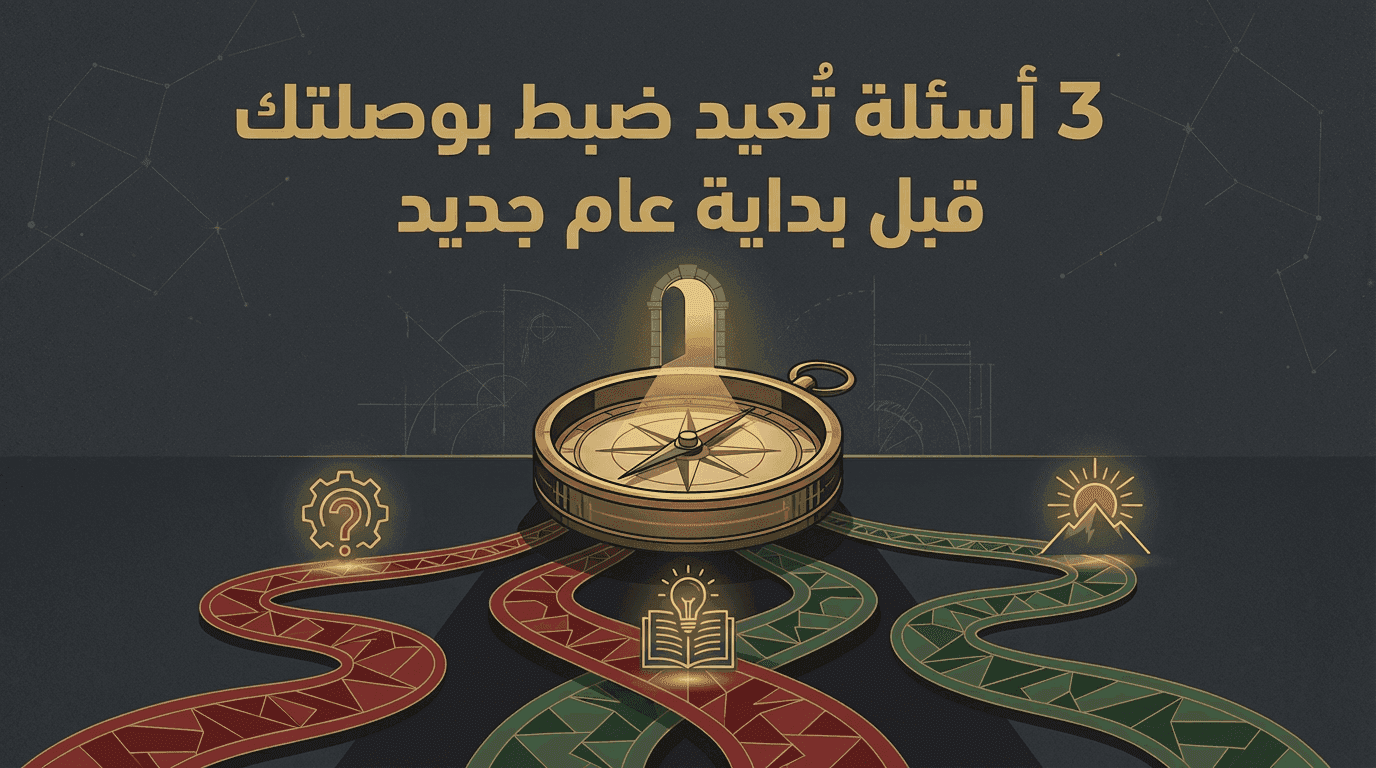
An annual review doesn't require complex templates or lengthy sessions. Sometimes, three honest questions are enough to put you on the right track.
First: What did I do for myself this year? (Three things)
This question seems simple, but it is revealing. The speed of your answer—or your hesitation—says a lot about your relationship with yourself. When we start the review from here, we rearrange priorities: you are not just an instrument of production, but the foundation upon which every achievement is built.
Self-care doesn't necessarily mean long vacations or radical changes. It could be a decision to set a healthy boundary at work, a commitment to a simple daily routine, or the courage to ask for help you've been putting off. It could also be a professional achievement that gave you a sense of stability or confidence.
The criterion here is not the size of the action, but its impact on you. What made you more balanced? What relieved your stress? What made you feel that you are managing your life with greater awareness? These answers draw the map of your true needs, not the ones imposed by the context around you.
Second: What are the top three achievements you accomplished this year?
An achievement is not a passing event, but the result of decisions and behaviors. Therefore, it is not enough to say: The goal was achieved, but it is more important to understand: How was it achieved? And what was my role in it?
The achievement may be personal or professional, small or large, but it must reflect your own contribution. Perhaps you developed a skill, led a project effectively, repaired a complex professional relationship, or made a difficult decision at a crucial time.
Pausing at your achievements gives you two important things: Confidence and Awareness.
Confidence that you are capable of moving forward, and awareness of what actually works. Ask yourself: What recurring behavior lies behind these successes? Is it discipline? Communication? Boldness? These are not just answers for the past, but tools for the future.
Third: What are the three most important lessons you learned this year?
No year is without heavy moments. Failures, tensions, decisions that didn't go as expected. But the true value doesn't lie in the event, but rather in the lesson that comes out of it.
Try to summarize each lesson into one clear sentence. A sentence you can return to later. It could be a lesson about your boundaries, about the timing of decisions, about people, or about yourself when put under pressure.
These lessons are your knowledge capital. Ignoring them means repeating mistakes, and keeping them means maturity. Write them down, review them, and make them a silent reference that guides your upcoming choices.
From Review to Launch
Many jump straight into goals and plans at the start of a new year, but without a solid foundation. Mindful reflection creates a bridge between what was and what will be. It helps you carry forward what worked, leave behind what drained you, and enter the next phase with calmer awareness and a more grounded resolve.
At Shurooq, we see that a beginning is not a date on the calendar, but a mindset. And these three questions are not just for the end of a year, but an exercise that can be returned to whenever you need to recalibrate your direction.
Begin with understanding... then set forth.