

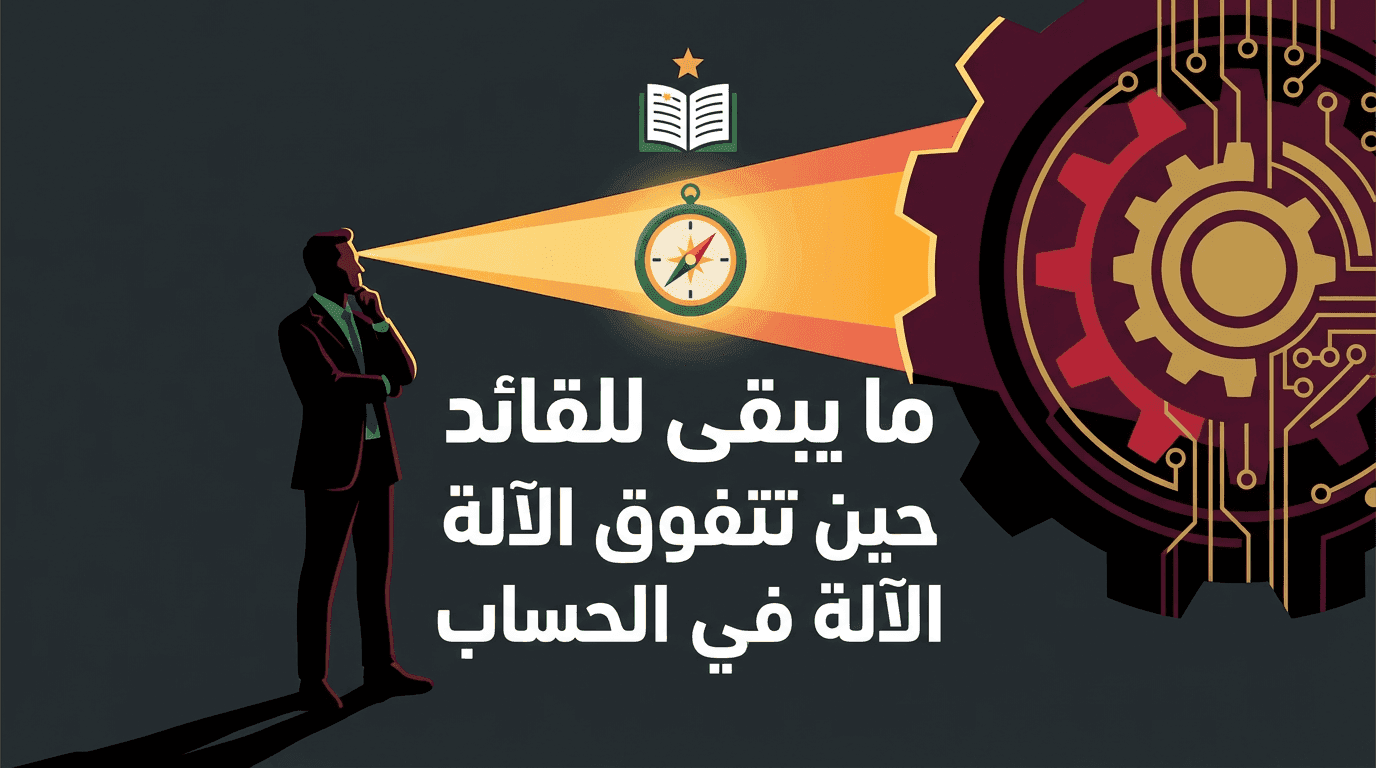
What is Left for a Leader When the Machine Excels at Calculation
Artificial intelligence is no longer just a supporting tool in the workplace; it has become an element reshaping the standards of performance and achievement. As much as it has provided immense opportunities for leaders and executives, it has also generated a new sense of anxiety: AI Imposter Syndrome.
This feeling manifests when leaders compare themselves to the machine in terms of speed, accuracy, and the ability to produce ready-made solutions. Suddenly, drafting a strategic report in two days feels slow compared to a system’s ability to complete it in minutes. However, the reality is that an executive leader's value is not measured by technical speed, but by their ability to make impactful decisions and lead people through complexities that transcend algorithmic capabilities.
Here is an expanded practical guide outlining how executive leaders can transform this feeling into a strategic opportunity.
1. Redefining Leadership Value
- Do not compare yourself to the machine; compare yourself to what your organization needs.
- Artificial intelligence excels at quantity, but the executive leader excels at strategic direction.
- Ask yourself: How do I ensure that the use of AI serves the organization's goals rather than driving them?
Practical Example: AI may be able to analyze market data with precision, but determining whether that data is sufficient to enter a strategic alliance or a long-term investment remains an inherently human decision.
2. Building Continuous Cognitive Fitness
- Thinking is a skill that requires training just like any muscle.
- Allocate time to use your mind away from digital tools: traditional brainstorming sessions, open discussions without screens, or even writing a plan by hand.
- These practices maintain the flexibility of the executive mind and grant it the ability to innovate beyond ready-made templates.
Practical Example: Turn your executive meetings into a space for "deviceless thinking," where the team is asked to discuss a strategic challenge without any technical support. The results are often deeper and more creative.
3. Treating AI as a Strategic Partner
- Do not view it as a competitor threatening your role, but as a partner that helps you raise the ceiling of executive thinking.
- Use it to test different scenarios, challenge your team's assumptions, or accelerate operational tasks.
- The smart leader is the one who knows where the role of AI ends and where the role of human decision-making begins.
Practical Example: Before making an acquisition decision, AI can generate alternative financial models, while the leader takes on the task of evaluating political and cultural risks—elements that the system cannot accurately predict.
4. Granting Space for Mistake and Experimentation
- In fast-paced environments, making mistakes might seem like a luxury, but in leadership, it is the foundation of learning.
- AI minimizes the scope of failure through ready-made optimizations, but it may deprive the team of a rich learning experience.
- Leadership requires granting yourself and your team the right to experiment and fail, because it is a source of innovation and growth.
Practical Example: Global companies like Amazon built their strength on the principle of "fail fast, experiment fast"—an approach that will never be replaced by AI, as it relies on a human culture of embracing risk.
5. Preserving the Human Dimension in Leadership
- Artificial intelligence does not possess empathy, a value-driven vision, or the ability to inspire others.
- A successful executive leader balances leveraging technology with fostering a human culture within the organization.
- Remember that true impact does not come from "fast decisions" alone, but from inspiring decisions that drive people toward commitment and change.
Practical Example: During organizational transformations, AI can suggest restructuring plans, but communicating with employees, calming their fears, and building trust remain purely leadership responsibilities.
Conclusion
AI Imposter Syndrome is a natural reflection of an era where standards are shifting rapidly. However, the executive leaders who succeed are those who do not occupy themselves with comparing themselves to the machine, but instead focus on multiplying their human strengths: vision, judgment, empathy, and the ability to turn mistakes into opportunities.
AI may excel at calculation and analysis, but it does not know how to invent a future, build a culture, or inspire a team. This territory will remain the exclusive domain of leaders.
Consequently, the real challenge is not how we compete with the machine, but how we use it wisely to enhance our leadership role.