

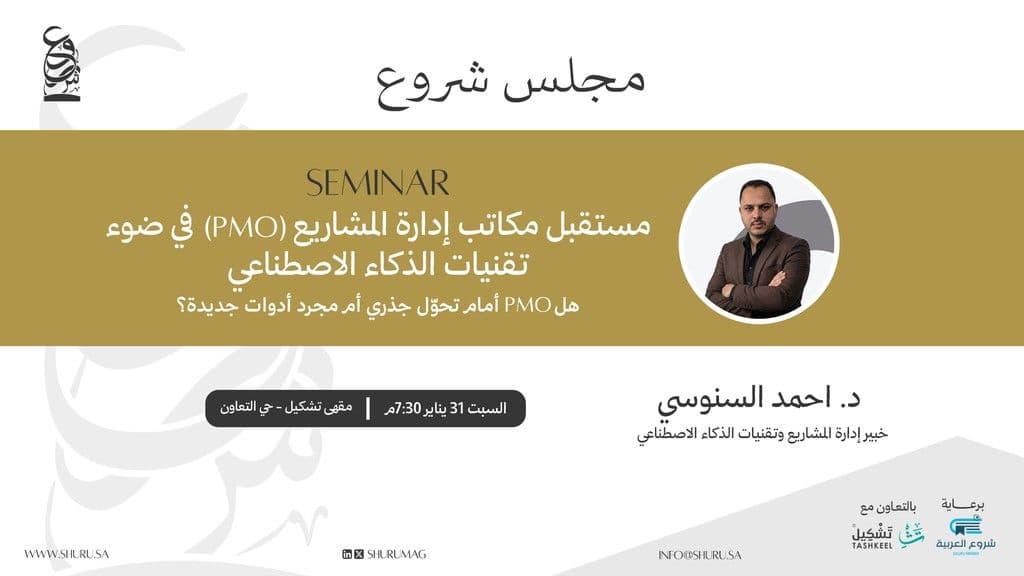
Workshop Description
In light of the increasing acceleration in the adoption of artificial intelligence technologies, the role of Project Management Offices (PMO) is no longer limited to tracking and reporting; it has become a central element in supporting executive decision-making and enhancing organizational efficiency.
This workshop aims to review the strategic transformation of the PMO role from a traditional operational model to an intelligent model based on predictive analytics, automation, and artificial intelligence agents. It also discusses the practical, organizational, and technical frameworks necessary to build an AI-Enabled PMO capable of managing projects and project portfolios in complex, multi-party environments.
Key Pillars of the Workshop
1) The Current Reality of PMOs in the AI Era
This pillar focuses on diagnosing the current state of PMOs and measuring their readiness for the transformation toward an intelligent PMO.
- Assessing the maturity level of the organizational PMO and its readiness for transformation into an AI-supported PMO
- Analyzing the gap between traditional operational models and those based on predictive analytics and decision-making
- Reviewing organizational, technical, and governance challenges for adopting AI in project environments
2) AI-Powered PM & PPM Platforms
This pillar discusses the role of intelligent platforms in enabling the PMO to manage projects and portfolios with higher efficiency at an organizational level.
- Classifications of platforms supporting governance, planning, and portfolio management using AI
- Integration of intelligent PMO systems with ERP, Business Intelligence (BI), and GRC (Governance, Risk, and Compliance) systems
- Criteria for selecting platforms from an institutional and executive perspective, considering sustainability and scalability
3) AI Agents and Their Impact on Task Execution and Performance Management
This pillar focuses on the shift from manual task management to operating models supported by intelligent agents.
- The role of AI agents in task distribution, automated tracking, and managing time and contractual obligations
- Hybrid operating models between human teams and AI systems
- The impact of AI agents on PMO structure, distribution of responsibilities, and decision-making pathways
4) Super Agents and Remote Work Execution in Multi-Party Project Environments
This pillar discusses the concept of "Super Agents" and their role in managing complex, multi-stakeholder projects.
- The concept of Multi-Agent Systems in coordinating projects and programs
- Managing vendors, reporting, and contracts through centralized intelligent execution systems
- Governance, security, and ethical frameworks for operating this model at an organizational level
5) Predictive Insights and Smart Dashboards to Support Executive Decision-Making
This pillar focuses on converting data into executive value that supports senior management.
- Using Predictive & Prescriptive Analytics in the PMO
- Designing executive dashboards linked to strategic goals and organizational performance indicators
- Empowering the PMO to be a strategic intelligence hub supporting senior management and leadership boards
Guests
د. أحمد السنوسي
خبير إدارة المشاريع وتقنيات الذكاء الاصطناعي